
Hello, it's me again. I'm back!
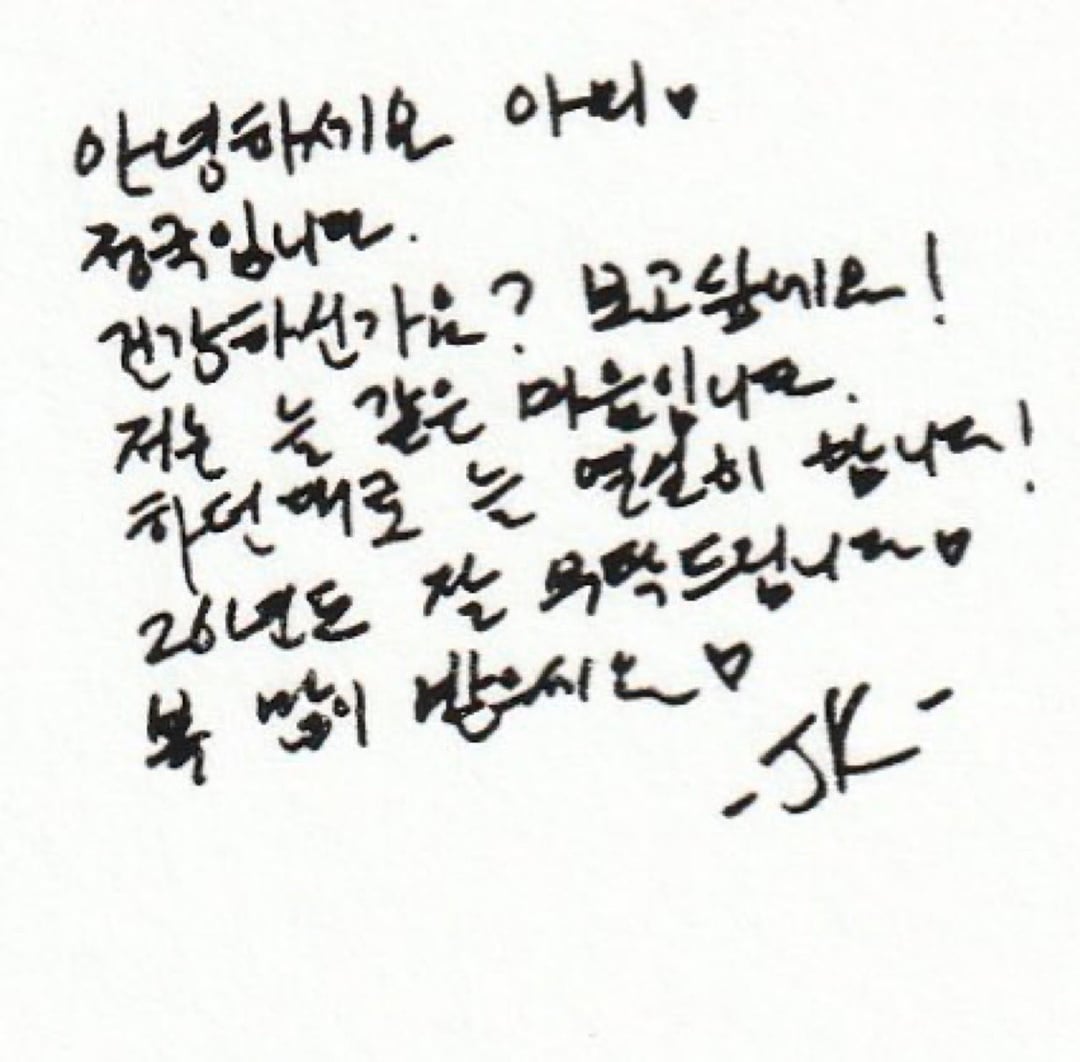
I was thinking about doing more of these Korean posts since you guys liked the last one, so I decided to tackle their most recent messages on Weverse. I might make individual posts for the other members, it just depends, but I'll just cover Jungkook's for now.
한국어
안녕하세요 아미 ♡
정국입니다.건강하신가요? 보고 싶어요! 저는 늘 같은 마음입니다. 하던대로 늘 열심히 합니다! 26년도 잘 부탁드립니다 ♡
복 많이 받으시오 ♡
English
Hello, ARMY ♡
This is Jungkook.Are you all healthy? I miss you! My heart has always remained the same. I keep working hard, just like always! Please take good care of me in 2026 as well ♡
Wishing you have many blessings! ♡
Grammar/Vocab:
- 안녕하세요 Hello (안녕하다 to be at peace; well + ~(으)세요 honorific style that can be used to express requests or to make very polite statements about other people)
- 아미 ARMY
- 정국 Jungkook + ~이다 to be; conjugated in the deferential declarative form ~(스)ㅂ니다. ~이다, unlike most verbs, is copular, which means it must be written without spaces and must be attached to the noun.
- 건강하다 to be healthy + ~시 honorific verb attachment + ~ㄴ가/나(요) it is the case that [verb]?
- 보다 to see + ~고 싶다 to want [verb] + ~아/어요 polite present tense
- 저 (I/me honorific) + ~은/는 topic marking particles
- 늘 always + N 같은 to be like [noun]\*
- 마음 heart, mind, feelings (often abbreviated as 맘) + ~이다 + ~(스)ㅂ니다
- 하다 to do + ~던* used to + 대로 as it is/was; as expected
- 열심히 diligently
- [#] + ~년 year\* + ~도 also/too
- 잘 well
- 부탁 request; favor + 드리다 (humble ver of 하다)* + ~(스)ㅂ니다 declarative deferential form
- 복 luck, fortune, blessing
- 많이 a lot; many
- 받다 to receive + ~(으)시오 (informal way of writing the imperative deferential form ~(으)십시오)
Additional notes:
- [N 같은]: this form is usually used when comparing two nouns, whereas N처럼 is usually used when linking a noun to an action or description.
- [던]: ~더 is usually used to mark the speaker's recollection of an event, and you can see it in other grammatical forms like ~던데 (I) found that… or ~더라고(요) (I) noticed/realized…
- [년]: This is just an extra fact, but if you attach 대 after 년, you can write the years within a ten year period. 90년대 the 90s, 80년대 the 80s. You can also directly attach 대 after a number when describing age: 30대입니다 I'm in my thirties.
- 드리다]: In the example 부탁드리다, I said that 드리다 is the polite version of 하다… well yes, in this case, as it replaces it in the general verb 부탁하다. 드리다 is always humble, and another usage of it is being a more humble version of 주다, which means to give. 부탁하다/드리다 is a way to make polite requests, but it sounds very odd to use for general items like water (stick to 주세요 on that one!).
- Furthermore in Korean, honorific usage can be a bit tricky, but usually when making requests using the general (~아/어)주다 please do [verb], you need to consider who is doing the action. If you are doing an action for a friend, sibling, or someone younger, you can use 주다, if you're offering an action for someone of higher status (a boss, elderly, etc), you can use 드리다, if you're describing an action that was done for you by someone of higher status, you can describe it using 주시다. 도와주셔서 갑사합니다 Thank you (higher) for your help. 도와드릴까요? Can I help you (higher)? 도와줘(요)! Help me (lower/equal)!
- When measuring levels of politeness in Korean speech, this is how I would structure it: ~(ㄴ/는)다 plain form (no audience, used in written work or to voice one's own thoughts) → ~아/어 informal (casual speech used among close friends or to those younger than you) → ~아/어요 polite (used with similar aged acquaintances, those older, coworkers, etc) → ~(스)ㅂ니다 deferential form (used the most in humble speech, to those of much higher status, in broadcasts, etc etc). The honorific verb attachment ~시 is commonly used in both the ~아/어요 and ~(스)ㅂ니다 forms. If you use google translate and it comes up with a ~(ㄴ/는)다 ending or an ending without a ~요… ur probably using informal speech… just be careful!
새해 복 많이 받으세요! Happy New Year!
by Lost-Opinion3554
2 Comments
Thank you! This gives so much colour to the message.
Thank you for taking the time to do this!! 💜
I love these types of explanations! Very cool.